We built the world on a dependency nobody declared
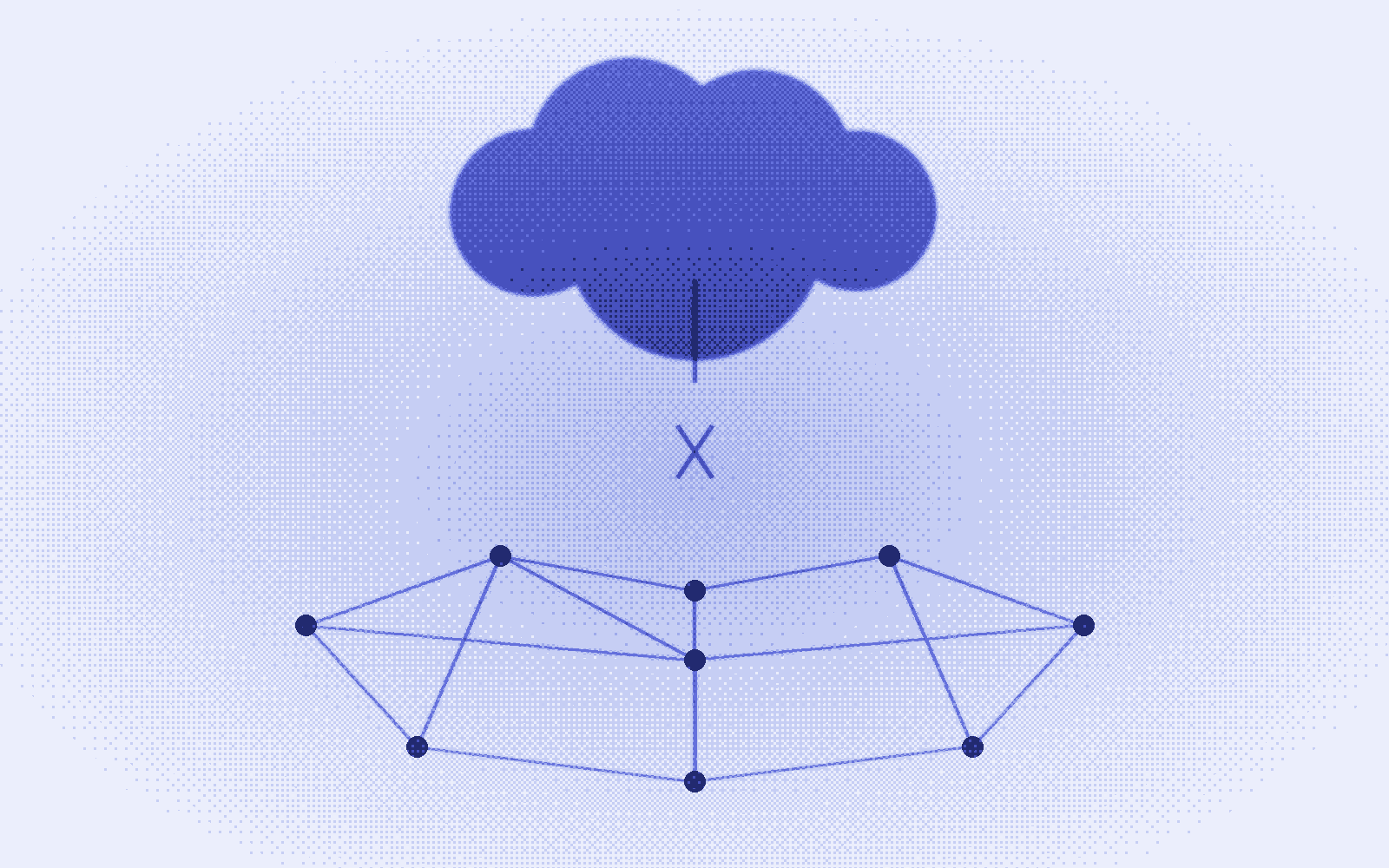
Open almost any system diagram and you will find an arrow pointing at a cloud. The arrow has no error case. It is not drawn as a dependency to be managed, with a timeout and a fallback and a plan for when it is not there. It is drawn as scenery, a fact of the world as reliable as gravity. That single unexamined arrow is the most widely deployed bug in modern software, and we shipped it everywhere.
The assumption is invisible until it isn’t
The reason the assumption survives is that it is usually true where software gets written. In an office, on a laptop, in a data center, the network is genuinely always there, so the arrow holds and nobody notices it was load-bearing. The code that “requires connectivity” never announces itself, because in the environment where it was built, connectivity was never in question.
Then the software leaves the building. It goes to a delivery route, a factory floor, a cargo ship, a rural clinic, a stadium at capacity, a disaster zone, a border. And in every one of those places the network is not a fact of nature. It is intermittent, congested, jammed, shut off, or simply absent. The arrow breaks, and because nobody ever declared it as a dependency, nothing downstream knows what to do. The device is not slow. It is not degraded. It is off, sitting in the exact place the work needed to happen, waiting for a link that is not coming.
The edge is not an edge case
We keep calling these situations edge cases, which is a tell. They are not rare, and they are not at the edge of anything except the network we happened to design for. They are where the physical work of the world gets done.
A logistics operation coordinates trucks and yards and docks in places chosen for warehouses, not for coverage. A ship spends weeks somewhere no cell tower reaches. A clinic runs where the clinic is needed, which is frequently where the infrastructure is not. An event packs tens of thousands of people into a space whose network was provisioned for hundreds. A response team arrives precisely because the normal infrastructure has failed. For every one of them, “no connectivity” is not an unlucky exception to plan around. It is the baseline condition of the job.
Software that treats those conditions as exceptions is optimizing for the environment where it was authored instead of the environment where it runs. That is exactly backwards.
Declaring the dependency is the whole move
The fix is not to make networks perfect, which no one can do. It is to stop pretending the network is free and always present, and to declare it as what it is: a resource that may or may not be available, that the system must be designed to work without.
Once you declare it, the design changes on its own. Devices need to discover each other without a directory. They need to coordinate without a coordinator. They need to move data without an end-to-end path, hold it when there is nowhere to send it, and reconcile when a link returns. They need to prove who they are to each other with no authority to ask. None of that is exotic; it is just the set of things you are forced to build the moment you admit the cloud arrow can break. Offline-first is not a feature bolted onto a connected system. It is what software looks like when the network is an input instead of an assumption.
The connected path still works
The objection is that all of this is effort spent on the unhappy path. But declaring the dependency does not cost you the happy one. A system that can coordinate locally still uses the internet gladly when it is there, as simply the longest and fastest link available. It just stops treating that link as the only thing standing between working and not working. When connectivity is present, it is an accelerant. When it is absent, the work continues at reduced reach instead of stopping. You lose nothing on a good day and you keep operating on a bad one.
Why it matters
The industries that run at the disconnected edge have made peace with unreliable networks in every part of their operation except their software, which still assumes the one thing the environment cannot promise. Closing that gap does not require heroics. It requires naming the dependency everyone has been drawing as scenery, and building for the world as it is rather than the office it was written in.
See where this holds up in practice across logistics, field operations, and public safety, or talk to us about the arrow in your own diagram.